
Introducing the H96 Max Plus
It’s been a while since a Rockchip-based TV box truly caught attention, but the H96 Max Plus enters the scene with some notable features. This compact device aims to deliver a robust media experience, powered by a significant 4GB of RAM and running on the Android 8.1 operating system.
This particular model, the H96 Max Plus, represents a fresh take on the Android TV box market, offering specifications that promise smooth performance. Given its availability at retailers like Walmart, it’s clearly positioned for the everyday consumer looking to enhance their home entertainment setup.
First Impressions and Design Choices
Right out of the box, the H96 Max Plus arrives in a straightforward cardboard package. This compact box keeps things simple, though it notably omits detailed specifications on the exterior, only featuring the model name.
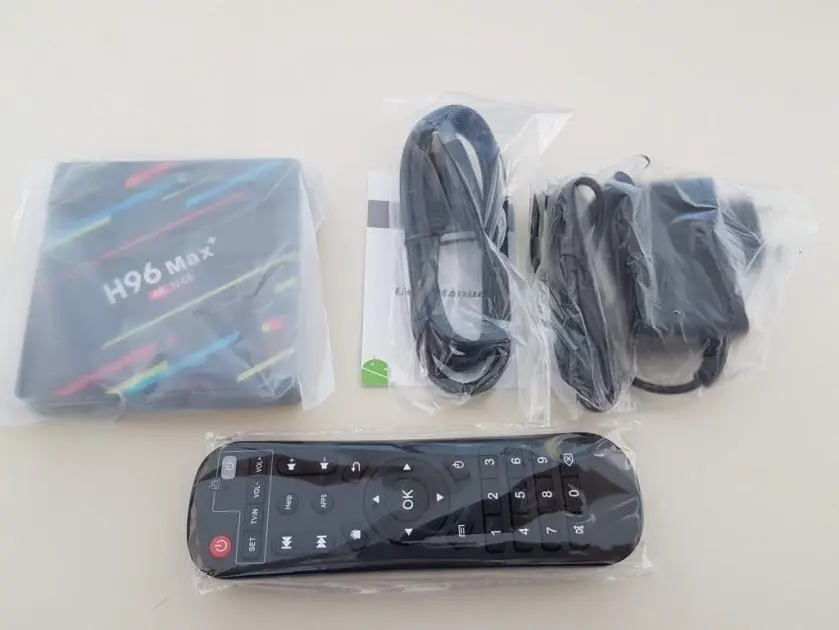
Unpacking reveals the main unit, a wireless RF-based remote control (you’ll need to supply your own batteries), a power supply, and an HDMI cable. Basic documentation is also included, guiding users through the initial setup.
The device itself is remarkably compact, measuring less than 100 x 100mm, allowing it to fit discreetly into any entertainment center. Its construction is entirely plastic, offering decent build quality for its category.
While the colorful top of the unit might not strike everyone as elegant, it certainly gives the device a distinct look. It’s worth noting the product was never positioned as a premium design piece.
You won’t find a display on the front of the H96 Max Plus, keeping its face clean and minimalist. All the necessary connection ports are thoughtfully distributed across the sides and back of the unit.
USB and micro SD slots are conveniently located on the sides, making them easily accessible for quick swaps. Essential connections like HDMI, RJ45 Ethernet, power, and the headphone jack are neatly lined up along the back.
Heat dissipation seems well-considered, with numerous ventilation holes covering the bottom of the device. This design choice likely contributes to stable performance during extended use, mitigating potential overheating issues.
The included remote is a familiar, generic RF model, often seen bundled with similar devices. It features numeric keys, and its layout is generally intuitive, making it easy to learn.
However, the menu key might catch you off guard, as it’s placed in the lower-left corner of the directional wheel, rather than the more common top-right position. For precise button presses, you will need to point the remote directly at the main unit.
Interestingly, the top row of keys on the remote can be programmed to control your TV. Clear instructions for this customization are conveniently printed on the back of the remote itself.
Hardware and Connectivity at a Glance
At its heart, the H96 Max Plus runs on a Rockchip RK3328 Quad-Core A53 processor, paired with a Mali-450MP2 GPU. This combination, alongside a robust 4GB of main RAM, forms the foundation for its system operations.
Media playback is a key focus, with the device supporting 4K and HDR content, ensuring vibrant visuals on compatible displays. Audio quality is also addressed, as it handles both Dolby Digital and DTS audio codecs for an immersive sound experience.
Storage-wise, the unit comes with 32GB of internal ROM, which should be ample space for most applications and media files. For those needing more, a 64GB version is also available, offering approximately 55GB of free space after initial setup.
Connecting peripherals is straightforward, with a practical selection of ports. This includes one USB 2.0 port and a faster USB 3.0 port, perfect for external drives or other accessories.
Display output is handled by an HDMI 2.0a port, capable of delivering high-quality video to modern televisions. Furthermore, a micro SD slot offers simple storage expansion, and a standard headphone jack provides an easy audio output option.
For network connectivity, the H96 Max Plus features an RJ45 port for a Mbit wired connection. Wireless access is provided through single-band Wi-Fi, though it doesn’t support the faster .ac protocol, and its signal strength isn’t particularly robust.
One notable omission is Bluetooth support, which limits options for wireless gamepads or audio devices. This means users will need wired accessories or those with a dedicated USB dongle.
The device comes with Android 8.1 pre-installed, making it one of the first TV boxes to ship with this version. The underlying APIs from Android 8.0 contribute to a noticeably better overall user experience compared to prior iterations.
The User Experience: Interface, Streaming, and Gaming
Navigating the user interface on the H96 Max Plus is surprisingly snappy, with only occasional minor lags. Application launch times are very good, thanks to the combination of the fast internal ROM and the generous 4GB of RAM.
The main user interface, while functional, is fairly ordinary and lacks a certain visual flair. It presents a single main screen adorned with colorful icons representing core applications and widgets, simplifying access.
Users have the flexibility to create custom shortcuts, helping to avoid frequent trips into the applications drawer. This personalization can streamline access to your most-used apps.
In contrast to the main screen, the settings menu will feel familiar to anyone accustomed to recent Android versions. It occupies the right side of the screen and is exceptionally easy to navigate, putting all major settings just a click away.
If you’re unsure about specific settings, it’s generally best to leave them at their default selections. This helps maintain optimal system performance and avoids unintended changes.
Audio playback truly shines, delivering very good quality for stereo files such as MP3s and FLACs. This holds true whether streaming from services like Spotify or playing music stored locally on the device.
Video performance is equally impressive, with stellar 4K playback capabilities readily available via the USB port. High bit-rate 1080p Blu-ray files also performed excellently over a wired LAN connection.
Even demanding scenes with peak bit-rates showed no buffering issues during testing over wired LAN. If you happen to encounter buffering lags, trying playback directly through the USB port might resolve the problem.
Unfortunately, automatic frame rate switching is not supported, requiring manual adjustments to prevent double frames and occasional juddering. Setting the device to 60Hz can offer a decent workaround, as the pull-down conversion functions acceptably.
A significant limitation is the lack of 4K VP9 format support, meaning you won’t be able to stream YouTube content in 4K resolution. Furthermore, the pre-installed YouTube application has an annoying bug where video playback stops when attempting to change the resolution.
Images generally appear sharp on screen; however, if you notice a darker picture, using calibration patterns can help adjust it to normal levels. This ensures your content looks its best.
Streaming through KODI add-ons is handled quite well, though there’s no audio pass-through to speak of. From the pre-installed Leia fork of KODI, only stereo sound was achieved.
Despite this, downmixing from HD Audio codecs worked effectively, ensuring stereo sound output from all tested codecs. This means you’ll still get audio, even from more advanced formats.
Access to popular video streaming services like Netflix and Amazon Prime Video is limited to SD resolutions. This restriction stems from the absence of proper licensing for higher-definition content playback.
For the same licensing reasons, Google-Cast functionality is also not supported on the H96 Max Plus. This means you can’t wirelessly cast content from compatible apps on your phone or tablet directly to the device.
Benchmarking results position the H96 Max Plus squarely in the mid-range category, showing performance similar to devices using the Amlogic S905X SoC. While generally acceptable, the internal ROM’s performance could be improved.
Gaming performance is sufficient for casual 2D games and lighter 3D titles, providing a decent experience for quick play sessions. However, you should definitely avoid graphically intensive games with heavy textures.
Attempting to play demanding titles will likely lead to disappointment due to low frame rates and choppy performance. The lack of Bluetooth connectivity further restricts gamepad options, requiring either wired controllers or those that use a USB dongle.
- **Powerful Core:** Features a Rockchip RK3328 Quad-Core A53 with 4GB RAM, providing a solid foundation for performance.
- **Latest Android:** Runs on Android 8.1, offering improved RAM management, better application handling, and updated security patches.
- **Impressive Media Playback:** Delivers stellar 4K video playback via USB and handles high bit-rate 1080p Blu-ray files well over wired LAN.
- **Good Audio:** Excellent stereo audio playback from both streaming services and local files, with effective HD Audio codec downmixing.
- **User-Friendly UI:** Despite a plain appearance, the interface is easy to navigate, and application launching is notably fast.
- **Connectivity Limitations:** Single-band Wi-Fi lacks .ac protocol, and crucial Bluetooth support is absent, limiting wireless peripheral options.
- **Streaming Service Restrictions:** Major services like Netflix and Amazon are limited to SD resolution due to licensing constraints.
What Happens Next
The H96 Max Plus represents a capable, budget-friendly Android TV box, especially for those prioritizing strong local media playback and a smooth Android 8.1 experience. Its strengths lie in its core hardware and decent video performance.
However, users interested in premium streaming service quality (beyond SD) or advanced gaming with wireless controllers might find its limitations frustrating. The device does offer an option for automatic system updates, though none were observed during testing.